How to Check Whether a Gambling Site Is Truly Licensed
A practical checklist for reading licence pages, operator details, regulator names, and responsible-gaming disclosures without relying on marketing slogans.
Start With the Operator, Not the Badge
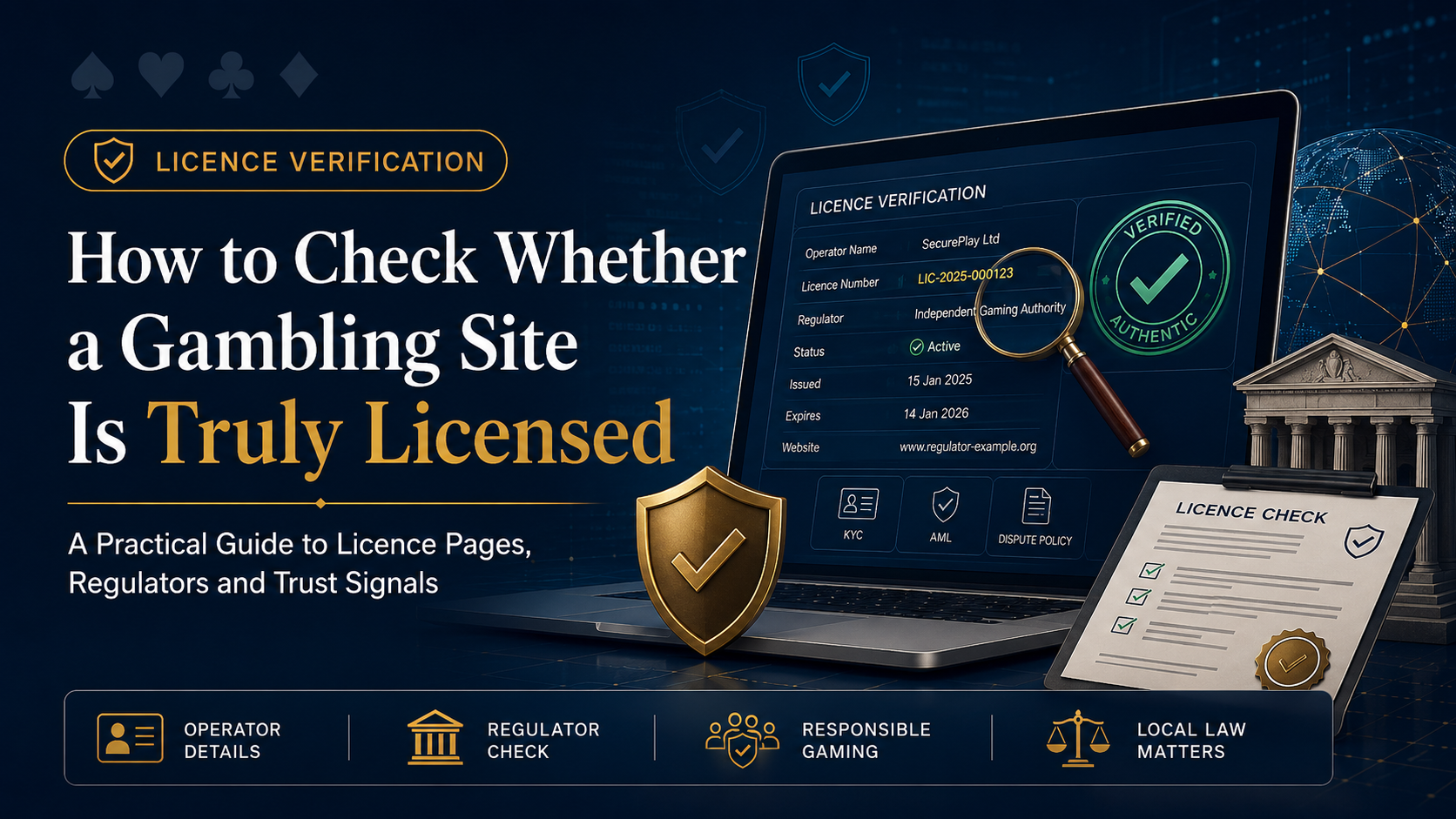
A licence badge in the footer can look reassuring, but it is not enough on its own. A proper licence check starts with the legal operator name, company address, regulator name, licence number, and the policy pages that support those claims.
The most common mistake is confusing the brand with the legal operator. Disputes, KYC checks, payment issues and complaint procedures are usually tied to the legal entity behind the brand, not the marketing name shown in the logo.
What a Real Licence Disclosure Should Include
- Legal operator name and registered company address.
- Regulator name and licence number.
- Terms and conditions, privacy policy, KYC and AML pages.
- Responsible-gaming information and age restrictions.
- Complaint or dispute-handling route.
If the site only says “licensed and regulated” without specific details, the claim is weak.
How to Read Curacao and Anjouan Claims
Curacao and Anjouan are common offshore licensing references in gambling content. A stronger disclosure names the operator, jurisdiction, licence number and regulatory wording clearly. A weaker one hides the number inside an image, shows inconsistent company details across pages, or relies only on a generic badge.
The practical method is simple: compare the footer, terms, privacy policy, responsible-gaming page and any dedicated licence page. The same company and licence details should appear consistently.
A Simple 10-Step Check
- Confirm the exact domain name.
- Record the legal operator name.
- Find the regulator and licence number.
- Match the operator name across the footer and terms.
- Check the privacy policy for the same entity.
- Read the responsible-gaming page.
- Read the KYC and AML pages.
- Check complaint and dispute-handling options.
- Compare payment pages with legal pages.
- Check local law, because offshore licensing does not equal local legality.
Red Flags
- No legal operator name.
- Vague licensing language with no licence number.
- Inconsistent company details across pages.
- No responsible-gaming section.
- Hidden KYC rules or vague withdrawal terms.
- Aggressive bonus promotion with weak legal disclosure.
For Indian readers, the final check is always local law. Offshore regulation may be one trust signal, but it does not override India’s 2026 online money-game framework.
Frequently Asked Questions
1. How do I verify a casino licence?
Check the operator name, address, regulator, licence number, policy pages and complaint route, then compare all details across the site.
2. Is a licence badge enough?
No. It is only one trust signal.
3. Does payment support prove legitimacy?
No. Payment options do not prove legal status, fair terms or safe withdrawals.
4. Why should I read KYC and AML pages?
Because they often affect withdrawals, identity checks and dispute outcomes.
5. What is the most important final check?
Local law in your own jurisdiction.